Marquise Lab-Grown Diamonds for Wholesale Jewelry Buyers
Marquise sourcing depends on length-to-width, point symmetry, bow-tie review and practical protection for both tips in the intended setting.
Request marquise options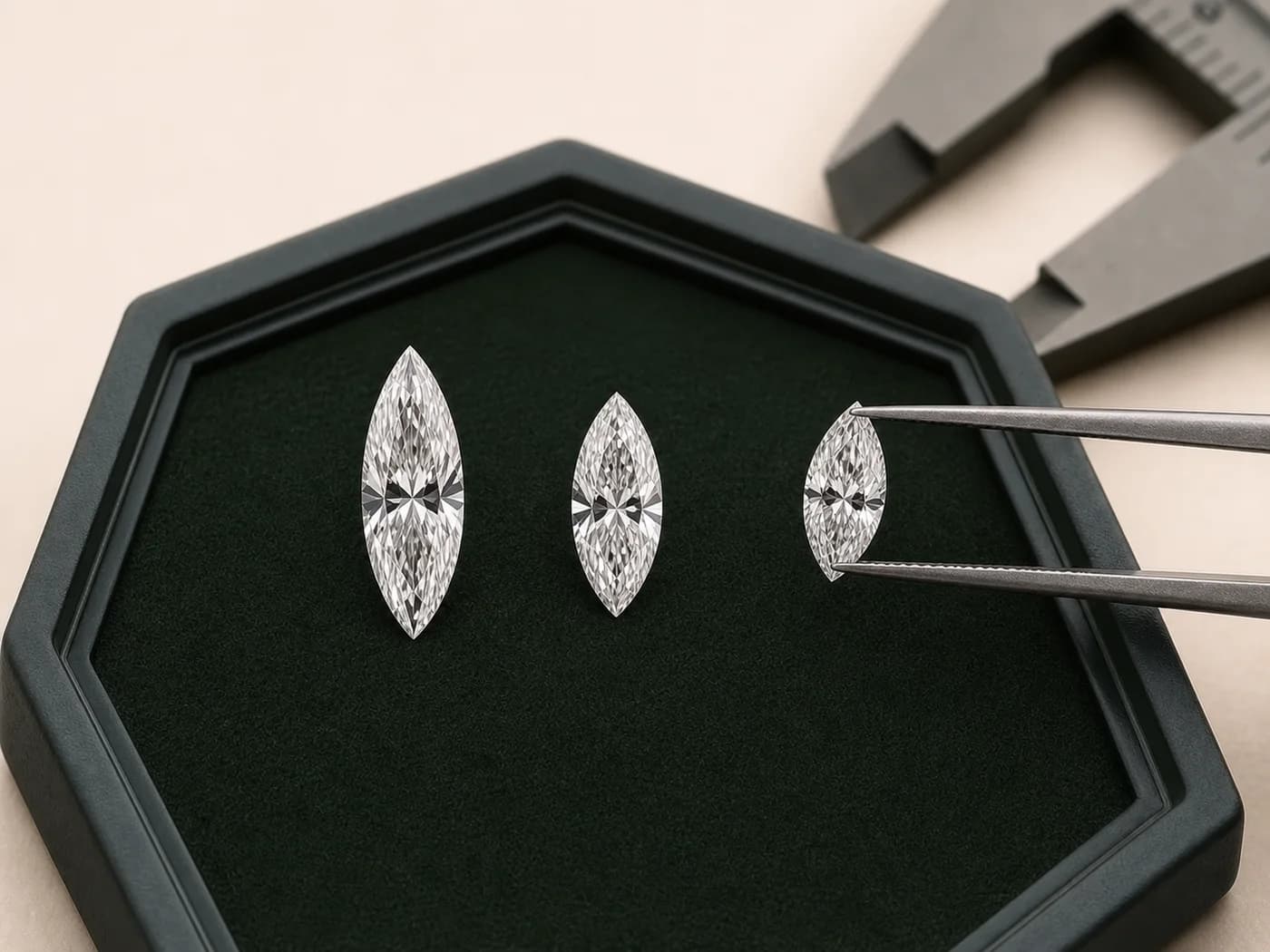
Length-to-width and visual spread
Provide the acceptable length, width and ratio rather than relying on weight alone. The ratio controls how slender or broad the stone appears and whether it fits an existing seat or layout.
Tip symmetry and outline risk
Both points should align with the center line, and the curved sides should create the requested balanced outline. Compare face-up media for tip alignment, shoulders and uneven bulging before approval.
Bow-tie and dark-area review
Request comparable face-up video where available and state the accepted contrast tolerance. Lighting affects appearance, so media supports comparison but does not replace physical verification.
Setting protection and matching
Use protective prongs or another approved construction around the tips. For pairs, compare dimensions, ratio, point alignment, grading and face-up pattern, then mark the required orientation.
Procurement checklist
Current marquise availability
Source by specification
Send the target carat, millimeter dimensions, ratio, grading preferences, quantity and jewelry use for a current supply check. The response identifies options that match the brief without presenting an unverified public inventory claim.
Request Current AvailabilityMarquise sourcing questions
Why do marquise tips need special attention?
Tip alignment affects symmetry, and the pointed ends need suitable protection in the finished setting.
Can marquise stones be calibrated as a pair?
Yes. Include exact dimensions, ratio, grading, tip symmetry, visual pattern and orientation requirements.
Does carat weight predict marquise length?
No. Proportions and depth affect face-up dimensions, so state a millimeter range.
Related shapes and sourcing services
Last updated: July 13, 2026